There is something deeply grounding about a purely mechanical machine. In an era where our wrists are dominated by microchips, lithium-ion batteries, and planned obsolescence, a mechanical watch is an act of rebellion. There is no electricity, no software, and no syncing. Whether it is a mass-produced daily driver or a high-end neo-vintage dress watch, it relies entirely on a highly refined sequence of gears, springs, and pure rigid body dynamics to chop time into precise, trackable fractions.
So, how does a scattered collection of brass, steel, and synthetic ruby actually track the rotation of the Earth? Let’s take the case back off and trace the path of energy from start to finish.
1. The Fuel Tank: The Mainspring and Barrel
Every machine needs an energy source. In a mechanical watch, that energy is potential and kinetic, stored within the mainspring.
The mainspring is a long, highly resilient ribbon of specialized alloy (often Nivaflex, designed to resist metal fatigue and magnetism) tightly coiled inside a brass drum called the barrel. As you wind the watch, you coil this spring tightly around a central arbor. The spring’s natural physical desire to uncoil generates a continuous rotational force, or torque.
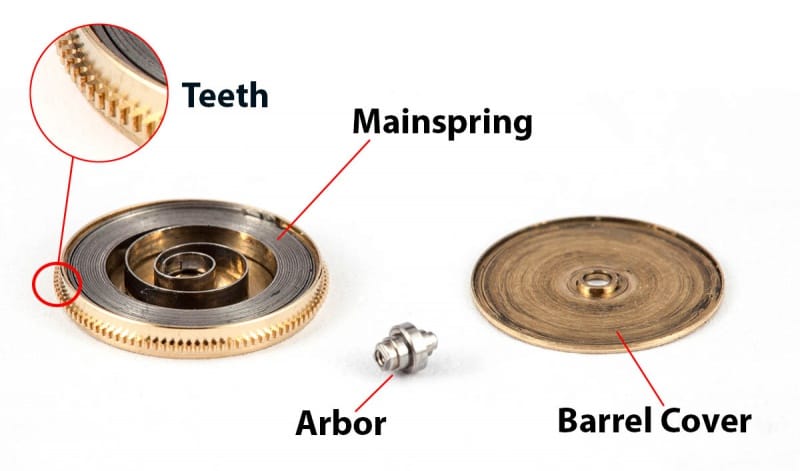
The Automatic Difference: In a manual-wind watch, if you keep winding once the spring is fully coiled, it will snap. Automatic watches have a clever fail-safe called a slipping bridle. The outer end of the mainspring isn’t permanently attached to the barrel wall. Instead, it grips the wall with friction. When the spring is fully wound, the bridle simply slides along the inside of the barrel, preventing the automatic winding system from destroying the movement.
2. The Transmission: The Gear Train and Jewels
If you let the mainspring uncoil freely, it would violently release all its energy in a few seconds. That immense torque needs to be stepped down into a usable, low-torque, high-speed rotation. This is the job of the gear train (or wheel train).
The barrel features teeth on its outer edge that mesh with the first of a series of specifically ratioed gears.
The center wheel is geared to rotate exactly once per hour, driving the minute hand. The third wheel acts as an intermediary multiplier. The fourth wheel is geared to rotate exactly once per minute, driving the seconds hand.
Why Jewels? Because these tiny metal pinions are constantly under heavy torque and rotating at high speeds, metal-on-metal friction would destroy the watch in months. Watchmakers use jeweled bearings—tiny, donut-shaped synthetic rubies. Ruby is incredibly hard (second only to diamond) and smooth, meaning the gear pivots can spin inside them with virtually zero friction or wear, aided by microscopic drops of specialized oil.
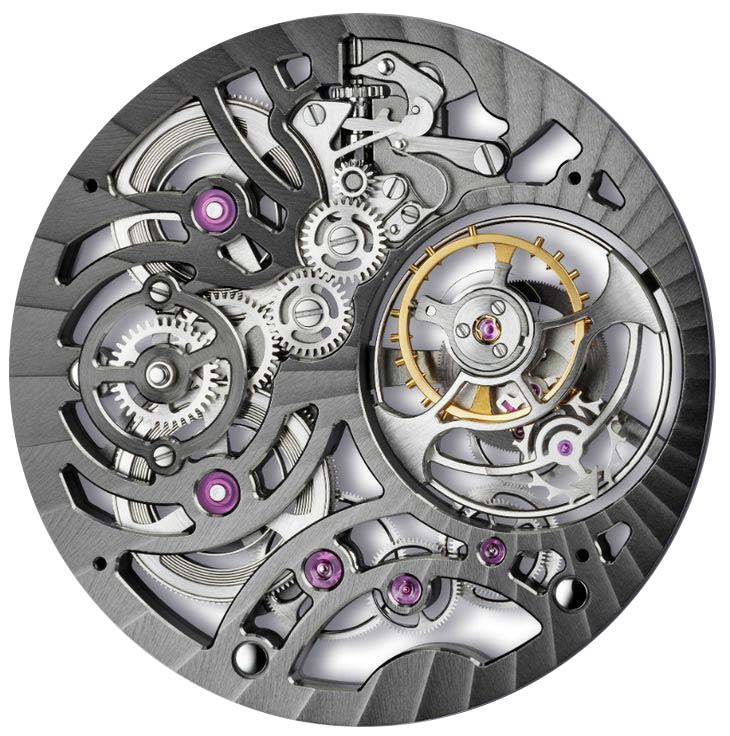
We can see the small purple colored jewels placed in areas where there is high metal on metal friction.
3. The Brakes: The Swiss Lever Escapement
Even with the gear train stepping down the power, the system would still spin out of control without a braking mechanism. This is where the rotational energy of the gears is converted into discrete, metered ticks by the escapement.
Most modern watches use the Swiss Lever Escapement, which consists of an escape wheel (with uniquely hooked teeth) and a pallet fork. The pallet fork acts like a seesaw. On each arm of the fork is a microscopic rectangular ruby, known as a pallet jewel.
As the escapement operates, these jewels alternate between locking the escape wheel and receiving an impulse (a tiny push) from it. When a tooth of the escape wheel slips off the polished face of a pallet jewel, it snaps forward and hits the next jewel. That physical impact—microscopic metal hitting synthetic ruby—is the literal “tick-tock” sound you hear when you hold the watch to your ear.
4. The Metronome: The Balance Wheel and Hairspring
The escapement brakes the gear train, but what tells the escapement when to lock and unlock? The regulating organ: the balance wheel and hairspring. This is a harmonic oscillator and the true brain of the watch.
The balance wheel is a perfectly poised, weighted disc. Attached to its center arbor is the hairspring, a spring so impossibly fine it looks like a human hair.
- The pallet fork gives the balance wheel a tiny physical kick.
- The wheel swings in one direction, winding the hairspring.
- The hairspring reaches its maximum tension, stops the wheel, and violently throws it back in the opposite direction, triggering the pallet fork to unlock the next gear tooth.
This happens at a staggering pace. A standard modern watch operates at a frequency of 4 Hertz, or 28,800 vibrations per hour (vph). That means the balance wheel swings back and forth 8 times every single second.
This system relies on the principle of isochronism—the physical rule that a pendulum (or a balance wheel) takes the exact same amount of time to complete a swing regardless of how wide that swing is. Whether the mainspring is fully wound or almost empty, the balance wheel keeps the exact same rhythm.
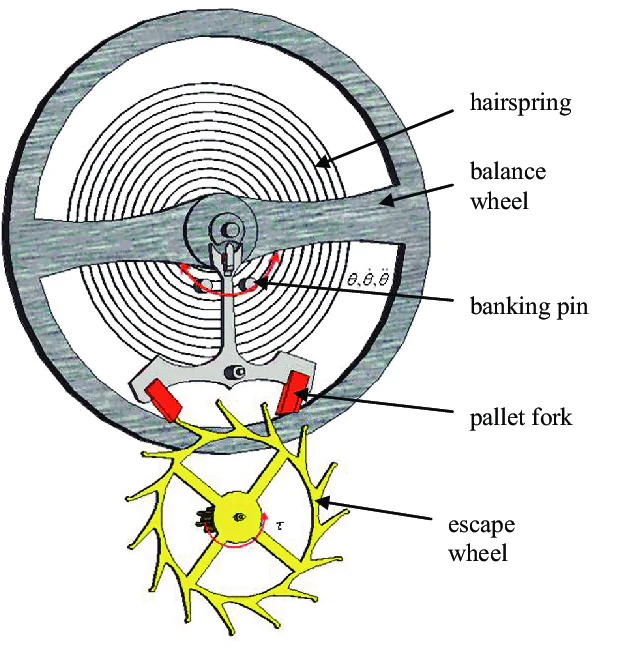
We can see here that the balance wheel and the lever arm work in Unison to keep the watch regulated.
5. The Kinetic Harvester: The Automatic Rotor
Everything above makes a watch tick. The automatic module is simply an ingenious way to keep the mainspring constantly fed with energy so you never have to manually wind it.
Mounted to the back of the movement is the rotor, a heavy, half-circle weight usually made of tungsten, gold, or heavy brass. Mounted on ultra-low-friction ball bearings, the rotor is highly susceptible to gravity and inertia. As you walk, type, or move your wrist, the rotor spins.
Because your arm movements are chaotic, the rotor spins clockwise and counter-clockwise randomly. To harness this, automatic watches use reversing wheels (or systems like Seiko’s “Magic Lever”). These take the multi-directional rotation of the rotor and convert it into a strictly one-way rotation that continuously winds the mainspring.
You are effectively taking the random kinetic energy of your own life, passing it through a mechanical rectifier, and using it to measure the heartbeat of the universe. Cool Huh.